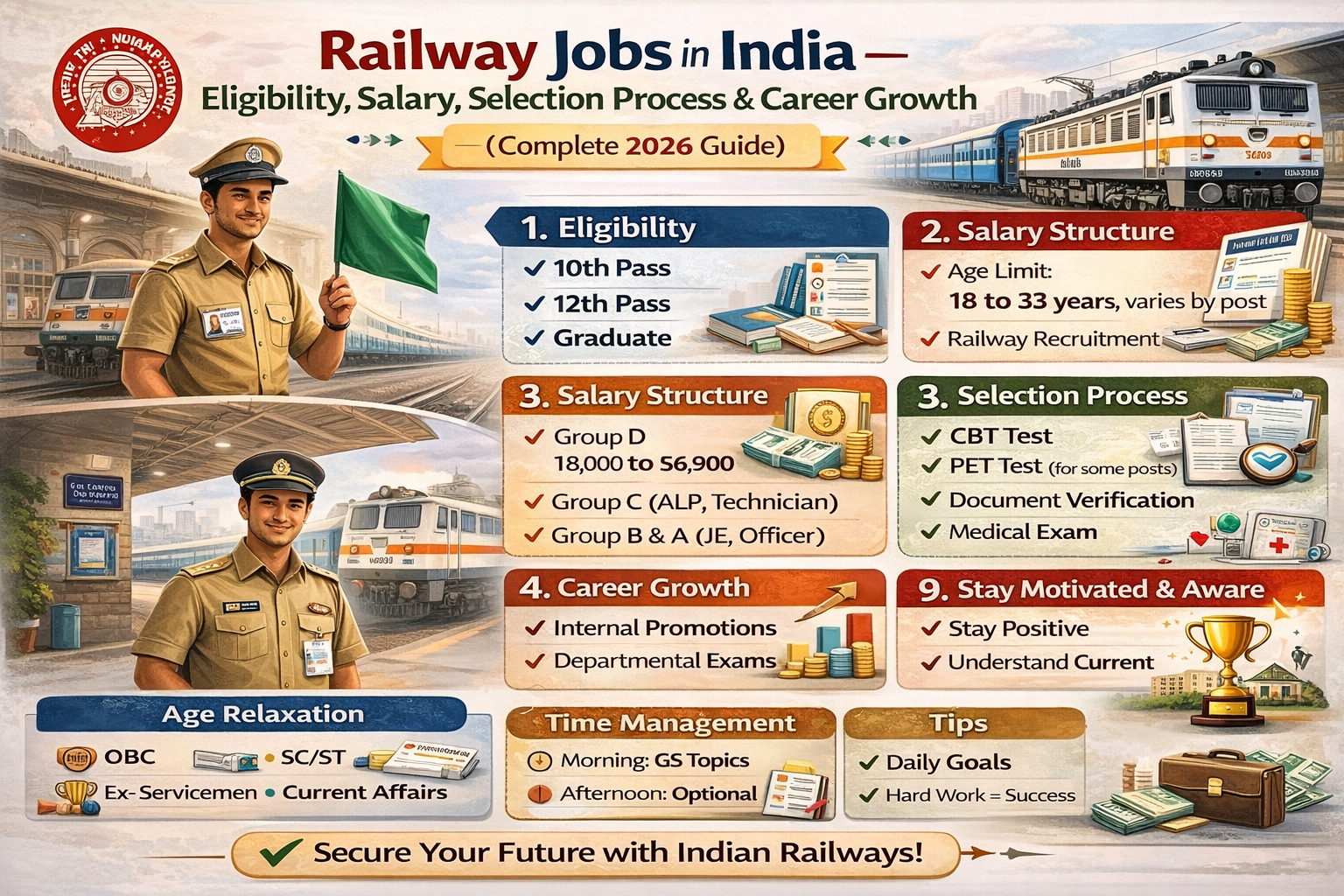
The Railway Recruitment Board (RRB) conducts recruitment for various Railway jobs every year. Railway jobs are among the most preferred government jobs in India due to job security, stable salary, allowances, and long-term career growth.
In this article, we explain everything about Railway jobs in India, including eligibility, salary structure, selection process, exam syllabus, and preparation tips.
Why Are Railway Jobs So Popular in India?
Railway jobs are highly popular in India because they offer:
-
Permanent government employment
-
Good starting salary
-
Dearness Allowance (DA)
-
House Rent Allowance (HRA)
-
Free or concessional railway travel passes
-
Pension and medical benefits
-
Work-life balance
Types of Railway Jobs in India
Railway jobs are mainly divided into the following categories:
1️⃣ RRB Group D Jobs
Posts Include:
-
Track Maintainer
-
Helper
-
Assistant Pointsman
Educational Qualification:
10th Pass / ITI
Age Limit:
18 to 33 years
Salary:
₹18,000 basic pay + allowances
(In-hand salary approx ₹22,000–25,000)
2️⃣ RRB NTPC Jobs
Posts Include:
-
Junior Clerk
-
Accounts Clerk
-
Goods Guard
-
Station Master
-
Commercial Apprentice
Educational Qualification:
12th Pass / Graduation
Age Limit:
18 to 33 years
Salary:
₹19,900 – ₹35,400 + allowances
3️⃣ RRB ALP & Technician Jobs
Posts Include:
-
Assistant Loco Pilot (ALP)
-
Technician
Educational Qualification:
ITI / Diploma in Engineering
Age Limit:
18 to 30 years
Salary:
₹19,900 + DA, HRA, TA
4️⃣ RRB Junior Engineer (JE)
Educational Qualification:
Diploma / Degree in Engineering
Age Limit:
18 to 33 years
Salary:
₹35,400 basic pay + allowances
(In-hand salary approx ₹45,000+)
Railway Job Eligibility Criteria (Summary)
| Criteria | Details |
|---|---|
| Qualification | 10th / 12th / ITI / Diploma / Graduation |
| Age Limit | 18–33 years (post-wise variation) |
| Nationality | Indian Citizen |
| Medical Fitness | Required for many technical posts |
Railway Job Selection Process
The Railway recruitment process is transparent and merit-based. The usual selection stages are:
1️⃣ Official Notification
2️⃣ Online Application
3️⃣ Computer-Based Test (CBT)
4️⃣ Physical Efficiency Test (for Group D / ALP)
5️⃣ Document Verification
6️⃣ Medical Examination
7️⃣ Final Merit List
⚠️ There is no direct appointment in Railway jobs without an examination.
Railway Exam Syllabus (Basic Overview)
Mathematics
-
Percentage
-
Ratio & Proportion
-
Profit and Loss
-
Time & Work
-
Simplification
Reasoning
-
Puzzles
-
Seating Arrangement
-
Coding-Decoding
-
Blood Relations
General Awareness
-
Current Affairs
-
Indian History
-
Geography
-
Polity
-
Static General Knowledge
Railway Job Salary Structure
Railway employees receive a salary as per the 7th Pay Commission.
Average In-Hand Salary:
-
Group D: ₹22,000 – ₹25,000
-
NTPC: ₹28,000 – ₹40,000
-
JE: ₹45,000+
Allowances Include:
-
Dearness Allowance (DA)
-
House Rent Allowance (HRA)
-
Transport Allowance
-
Free / Concessional Railway Pass
Career Growth & Promotion in Railway Jobs
Railway jobs offer excellent promotion opportunities:
-
Departmental exams
-
Seniority-based promotions
-
Higher pay levels over time
With experience, employees can reach officer-level positions.
Railway Exam Preparation Tips
✔ Understand the syllabus clearly
✔ Practice previous year question papers
✔ Attempt weekly mock tests
✔ Focus on speed and accuracy
✔ Revise regularly
With 3–6 months of disciplined preparation, cracking Railway exams is achievable.
Advantages and Disadvantages of Railway Jobs
✅ Advantages
-
High job security
-
Stable income
-
Government benefits
-
Good promotion system
❌ Disadvantages
-
High competition
-
Transfers in some posts
-
Long recruitment process
Conclusion
Railway jobs in India offer a secure, respectable, and stable career for candidates with qualifications ranging from 10th pass to engineering graduates. With proper planning, regular practice, and patience, candidates can successfully secure a Railway job.
Railway recruitment is fully transparent and exam-based, making it one of the safest government career options.